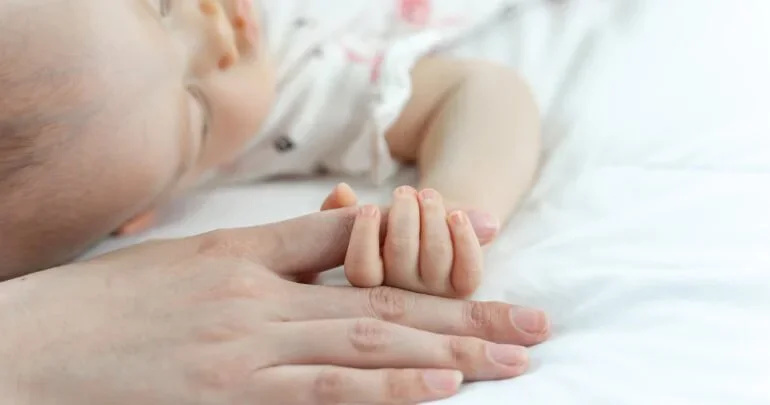
I had never seen a newborn like this one. It made me sad, but I still had hope that therapy would help him.
For only being on the planet for eight weeks, he had run the gamut of major infant pathology. His mom said that his main problem at birth was spinal bifida, which required surgery.
He had bilateral clubfoot with casts on his legs reaching his upper thighs. At the same time, he had bilateral hip dysplasia.
He was also born with a cleft palate and had hydrocephalus that required a shunt. During my exam, I found that he has a severe tongue tie with a retruded jaw.
He presented with the expected zero-second brain cycle and fascial strain patterns from his pelvic floor into his head. I was not able to palpate through the casts, but anticipate the typical clubfoot and leg strains.
I felt that the hand he was dealt was almost too much for any human to bear.
As a therapist, where do you start? I spent the entire first visit with his pelvic floor and lower back as he presented a severe fascial twist. I will continue to work up his body in future sessions and check his legs when the casts are removed.
When dealing with an infant with a shunt, I have always looked at the risk/reward ratio of the Gillespie Approach. I have never felt confident that the new surgically created cerebrospinal fluid flow pattern would be compatible with the natural pattern coming out of zero-second brain cycle. For that reason I have always avoided working with infants with a shunt.
But for this infant, there was so much major pathology that I felt it was worth the risk to help his body function better. I told his mom that I wish I could have seen him at birth because the castings and shunt surgery may have possibly been avoided. Immediate care for every newborn is my wish for the world.