A Mother Inquired in an Email
"I am writing to see if you think you can help my three-year-old daughter, who was born with torticollis. While it was resolved completely by 18 months, she has demonstrated continued mild gross motor delays by not jumping, only using one leg on the stairs, and using caution with swings and slides.
"I have seen so many physical therapists (8), a craniosacral therapist, an occupational therapist, chiropractors (2), osteopaths (2), and spent hundreds of hours online researching for an answer. The only two things that made a substantial difference were (1) TMR tots, (2) biodynamic osteopathy (unfortunately, our provider moved away).
"We are still doing physical therapy and TMR exercises at home. While it's helpful, it just feels like progress is always so slow.
"Underlying fascial tightness and imbalance seem to recur as soon as I stop TMR. Based on your testimonials, as well as the similar focus of your [approach] to those that have worked with us before, I am very, very hopeful that you would be able to help my daughter.”
My Initial Thoughts
As I have discussed in many torticollis posts, there is probably fascial twisting in her pelvis that has corkscrewed through her trunk and into her neck (torticollis) and head (plagiocephaly). The upper body was “corrected," but the root of the problem in her pelvis was never addressed. I believe that is probably causing her gross motor delays.
I wish that I could tell every torticollis provider in the world that what everyone sees as a neck condition can be rooted in pelvic fascial strain.
The Office Visit
She presented with an adequate 90-second brain cycle, and the fascial web in her upper body felt loose. As I had suspected, there were major lower-body issues.
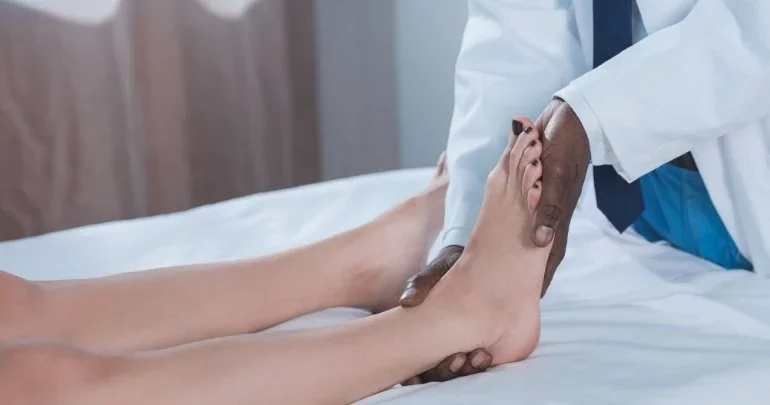
Both of her feet and ankles had different strains leading into a pelvic twist. This probably explained what mom was seeing with her mild gross motor developmental issues.
Two unusual things happened in therapy. After I spent quite a bit of time working through the foot and ankle strains, mom amazingly noticed that her feet now had arches.
Even more startling, I found that the pelvic twist found on examination had mostly resolved—wow. She ended the visit with a 210-second brain cycle.
I deduced that the fetal strains in her feet and ankles had created the pelvic twist. That, in turn, resulted in the neck torticollis, which the many providers had seen and nicely worked through.
Sometimes common sense prevails to get at the root of the problem. Since we are vertical beings who stand and move, if the feet and ankles are not happy in the fascial web, nothing above it will be happy.
For providers, be sure to check everyone's feet and ankles. Gillespie Approach Training is a must for healthcare practitioners.
Mom Speaks
"Here are some of my observations after a week:
- She has made more gains with her gross motor milestones in the past week than she has in the past six months! She can now walk up and down the stairs alternating feet with support (prior to this she could barely walk one step at a time with her left leg and was very reluctant to do so as if it was uncomfortable). She is able to jump off a small platform more or less symmetrically 20% of the time (prior to this she was unwilling to jump at all).
- Her physical therapist remarked that her arches were much better and that she was surprised how much better she was at balancing exercises.
- She climbed a large playground climbing wall very easily. Before therapy, she refused to climb it.
"This has definitely been the most effective therapy we have done so far. I am actually pretty surprised that even the providers who seemed really good did not notice her remaining pelvic twist or foot strain.
"Even the best one had put us on a maintenance plan as if he had addressed most of her issues. It is a little scary to think she could have been dealing with residual conditions from those strains her entire life if we had not found this therapy!"