I have a special interest in scoliosis because a chiropractor diagnosed me with that condition in 1980 at the age of 33. I had no family history and wondered how it could have happened to me.
Since then, I have developed a greater understanding of pathological structural issues and would like to present a hypothesis. This would be hard to prove scientifically because it may be unethical to have an untreated control group.
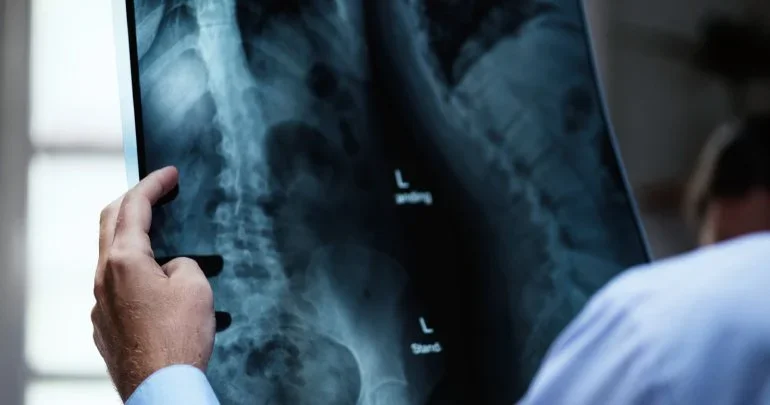
I would like to lump together all three common spinal abnormal conditions: scoliosis (a sideways curvature of the spine), kyphosis (a rounding of the upper spine and back), and lordosis (an accentuated inward curve of the lumbar spine, or swayback). I believe that they all may be rooted in birth trauma.
My mother’s obstetrician said she would not be able to conceive because her uterus was loaded with fibroids. But at 35, I snuck in as the only child, probably battling for space during my development in the fibroid forest.
In 1947, I had a “normal" vaginal delivery with no forceps. As a frame of reference, the Apgar score became the standard of care in the 1950s, and the first NICU opened in 1960 at Yale New Haven Hospital—where I was born.
I first started to think about the root cause of scoliosis in 2007 during the Lancaster research. A few of the babies had unusual twists in their trunks that worked out nicely over a series of visits. I wondered what would have happened to them as children and adults without treatment?
All 40 trillion cells of the body are interconnected in the fascial web. If we just considered the trunk, every muscle cell and every bone cell of every vertebra and rib are an integral part of this web.
If there is fascial twisting in the trunk from birth trauma, it would stand to reason that, left untreated, the skeleton would later present in an abnormal position. That strain could also possibly extend into the head, causing orthodontic misalignment, deviated nasal septa, eye issues, and other cranial problems.
No one was asking the question why scoliosis was happening, but just managing the condition with bracing, surgery, and other means. We are always searching for the root cause of a condition.
My chiropractor told me there was no treatment because of my advanced age. I refused to accept that statement as true. Instead, I had years of deep muscle and myofascial release (MFR) therapies to free up my tissues and start the corrective process.
Today, at 77, I take no medication, my trunk feels good, and all of my enclosed body systems function well. I am proof that the body can still heal scoliosis as an adult.
My situation offers hope for patients with spinal curvature. It may be a long haul in therapy, but the reward can be a more comfortable aging process.
If these issues truly originate from birth trauma, that is another great reason for the Gillespie Approach at birth. Someday, our work will be the standard of care for every newborn in America. Gillespie Approach Training can unlock the healing door.