

House excels at everything he does. He is charismatic and passionate about sports, especially ice hockey and lacrosse. He does well in school. All in all, he is a great kid.
As our first child, he had a rough delivery. After seventeen hours of labor with three hours of pushing, I was so exhausted that I did not ask if his latching was a problem. The nurse and lactation consultant told me it was correct.
During a routine pediatric visit, I had to rush House to the ER to have his bilirubin level checked since he dropped significant weight after leaving the hospital. I did not know he was not getting enough breast milk due to his poor latch.
At that point, I could not recover my production levels even with a pump. I never knew until now that his inability to latch was a Gillespie Approach issue. We had to feed him with sensitive formula, as regular formula would upset his stomach.
At 4 months of age, my husband and I were horrified when House was seizing in my arms. An EEG and MRI showed no evidence of any neurological condition. Doctors at Children’s Hospital of Philadelphia vaguely diagnosed him with benign fetal movements.
At 4 years of age, we noticed his stature was slipping, as his friends were much taller. We apprehensively trusted the doctor’s word that this was normal. Our son was just a short kid.
We were always careful to feed him organic, GMO-free food. We staggered his vaccinations, so he had one at a time. We built him up in between with probiotics. Even though we were conscious about his health, his growth kept sliding down the charts.
He was uncharacteristically wearing out ice skates before he grew out of them. He was far below his average-height friends. I would tear up when we would see a friend after summer break, who had gained inches. It really seemed to bring attention to the fact that our son had not. I would mention this to his doctor, who would say, “Someone has to be the shortest.”
I insisted we seek alternative measures. When I took House to an Ayurvedic physician, a chiropractor and an herbal nutritionist, he grew a half-inch in a short period of time. I was thrilled. Yet it was a commitment on every level—emotionally, physically and financially.
C’mon, let’s be real here. I cannot get my wonderfully cooperative kids to drink cod liver oil, even if it is cherry-flavored. I spent so much money on drops, supplements and alternative appointment visits with little concrete results.
It was time to see an endocrinologist and a GI specialist. House’s body was absorbing his nutrients, but the endocrinologist was cautious in her evaluation process. Meanwhile, he switched schools, and repeated the second grade. He was shorter than even the petite girls in his class, even though he was one of the oldest. He had slipped on the charts from 30th percentile to below 4th percentile.
He started growth hormone therapy at the end of his second, second grade. It took me a long time to accept that my son needed daily shots of human growth hormone. I knew in my soul that he desperately needed it. Within three weeks of starting the medicine, his knuckles filled out. His hands started to look older than his sister’s, who is three years younger.
This past summer, House was constantly nodding his head. I had seen him nodding his head during hockey practice and at games, but I thought it had to do with his hockey helmet. His teacher brought it up to me at a conference. She thought it happened when he was anxious.
I also noticed he was clearing his throat rather incessantly. I thought this had to do with allergies or asthma. He also had unexplained leg pain. By mid-summer, he was nodding his head every three seconds. The fear of the unknown presented to my husband and myself. The endocrinologist did not think his increased dosage of growth hormone the month before was contributing but lowered his daily dosage nonetheless. I mentioned Dr. Gillespie to her, and she encouraged me to pursue this option. I scheduled an appointment with him the next morning.
I then spoke to his pediatrician. She told me we both needed psychiatric treatment to get to the root of my son’s anxiety. I was most likely projecting my own fears on him, therefore aggravating his tics. She also told me to follow up with a neurologist.
I had heard of Dr. Gillespie the previous summer just when we started the growth hormone treatment. Someone mentioned his work with infants, and mothers blaming themselves for their milk not coming in. Hello! This was me. I blamed myself and felt so guilty the first three months of my son’s life. I felt like I had failed him. I knew then, I wanted to meet with Dr. Gillespie, and felt it would help with his growth hormone issue. Exhausted from pursuing so many alternative practitioners, I did not reach out at that time.
When we eventually saw Dr. Gillespie for the first visit, House’s tics went from every three seconds to maybe one tic in twenty minutes. After the second session, maybe it was one or two a night, and by the third session, they were all but undetectable.
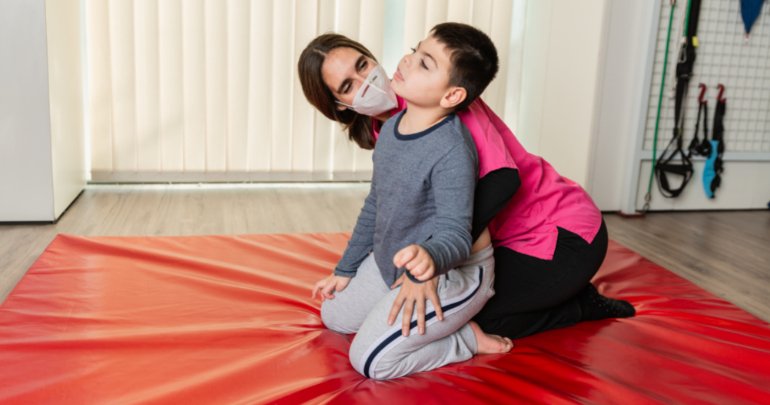
These sessions were not comfortable, and House was a trooper. After each session, he felt so much better that he wanted to go back and continue. At two different points during treatment, House collapsed like a rag doll. Each time as he was “recovering,” I could see his facial expression, smiling even before he opened his eyes. It was a natural reflex for the release and the relief he was experiencing. It was amazing to witness.
After 12 sessions, Dr. Gillespie felt House was pretty “loose.” His brain cycle, which started at zero, was over three hundred seconds. His life is now so much more comfortable. His throat feels better, his leg cramps have subsided, and he is tic-free. Reading is easier and he is simply healthier all around.
We are so grateful that this work helped our son. Dr. Gillespie was the first person who validated my suspicion that these conditions were all related. His craniosacral fascial web was tight, and no one noticed. We are excited to see how this continues to unfold and would love to see him no longer need human growth hormone.
I later decided to attend the CFT training for my son’s continued support and to help my entire family. After learning more about this modality and witnessing so many positive experiences, I saw that it is a great way to be proactive about health.
Dr. Barry Gillespie Addition
The Gillespie Approach’s goal is the identification of birth trauma with the Baby Brain Score (BBS) and continuing craniosacral fascial therapy (CFT) throughout the first day of life, if needed. Especially with a long labor, the main objective for House would have been to leave the hospital on day two with our five important life skills: breathing, nursing, digesting, pooping, and napping well.
We will never know exactly what may have been prevented with this scenario, but I believe that he may have been a happier/healthier child with a different family outcome.
A special note for Michelle’s deportment during the therapy sessions: When House collapsed like a rag doll, she quickly jumped in to assist me and fully trusted the healing process. He was compromised with a craniosacral fascial system that had multilayered full-body pulling creating many diverse conditions.
It saddens me to think that millions of people are now living with similar preventable issues due to a rocky birth. Please join us in changing the lives of the unborn.